
SiFli Solution is now fully open: a production-ready solution set that accelerates projects from prototype to mass production. Solution Documentation.

SiFli-Wiki SiFli-Wiki SiFli-Wiki
  • User Guide
  • Examples
  • API Documentation
  • About Us
/
  • English
  • 中文

Quick Start

  • Getting Started
  • Product Documentation Summary

Software Development

  • SDK Programming Guide
  • API Documentation
  • Solution Programming Guide
  • FAQ Frequently Asked Questions
    • Development Tool-Related Issues
      • 1 Compilation-Related
      • 2 Jlink
      • 3 KEIL
      • 4 Ozone
      • 5 SiFli
      • 6 Trace32
      • 7 SystemView
      • 8 UART
      • 9 Source Insight-related
    • Chip-Related Issues
      • 1 GPIO-related
      • 2 Timer-Related
      • 3 Interrupt-related
      • 4 Watchdog-Related
      • 5 RTC Related
      • 6 ADC Related
      • 7 I2C-related
      • 8 Low Power-Related
      • 9 PWM
      • 10 System
      • 11 Bluetooth
      • 12 USB-Related
      • 13 UART-Related
      • 14 Dual-core Related
      • 15 I2S-related
      • 13 SPI Related Issues
    • Peripheral Driver Debugging Issues
      • 1 Common LCD Debugging Issues
      • 2 Common Sensor Debugging Issues
      • 3 Common Flash Debugging Issues
      • 4 Common Motor Debugging Issues
    • Software Debugging-Related Issues
      • 1 Log Debugging
      • 2 Online Debugging Method
      • 3 Restoring the Crash Context from a Memory Dump
      • 4 Methods for Saving the Crash Context
  • Application Notes
    • Low-Power Development Guide
    • Application Startup Flow
    • NandFlash_BBM Analysis Guide
    • SF32LB52-DevKit-Core-3p3 Development Board Test Guide
  • Best Practices
    • AI Xiaozhi

Hardware Development

  • SiFli Selection Guide
    • SiFli Chip Model Guide
    • Module Model Guide
  • Chip Hardware Design Guide
    • SF32LB52x Hardware Design Guide
    • SF32LB52X Hardware Design Guide
    • SF32LB56xU Hardware Design Guide
    • SF32LB56xV Hardware Design Guide
    • SF32LB58x Hardware Design Guide
    • SF32 Series UART Automatic Flashing Design
    • SF32LB55x Hardware Design Guide
    • SF32LB52-MOD-1 Module EPD Display Design Guide
  • Development board
    • Development Board Model Guide
    • SF32LB52-DevKit-LCD Development Board User Guide
    • Guide to Making an LCM Adapter Board for SiFli Development Boards
    • Lichuang Huangshan Pi Development Board User Guide
    • SF32LB52-DevKit-Nano Development Board User Guide
    • SF32LB52-DevKit-Core-3p3 Development Board User Guide
    • SF32LB52-OED-6’-EPD Development Board User Guide
    • SF32LB56-DevKit-LCD Development Board User Guide
    • SF32LB58-DevKit-LCD Development Board User Guide
  • Module

Software Tools

  • Software and Hardware Tool Summary
    • Firmware flashing tool Impeller
    • Graphics Conversion Tool
    • Storage debugging tools
      • Flash Chipid and Type Configuration Guide
    • Screen module debugging
      • Screen module introduction
      • Display module framework introduction
      • Directory structure introduction
        • External
        • Built-in
      • Add display module (1) – Add files (copy files)
      • Add display module (2) – Modify the copied driver files
        • Modify the screen driver
        • Modify the screen TP driver
        • Modify the screen backlight driver
      • Add display module (3) – Modify Kconfig/Menuconfig
      • Example operations for adding a display module
        • SF32LB52x-DevKit-LCD example: adding an SPI-LCD (external)
        • Example: adding a QSPI-LCD on 525 (built-in)
        • Example: adding a DPI-LCD on 566 (built-in)
      • FAQ
      • Appendix
        • Display driver callback functions
        • Mapping table between application-layer functions and module driver-layer functions
        • List of adapted display modules
      • LCD frame-rate calculator
    • sftool

Product Introduction

  • About SiFli

On this page

  • 3.1 Pulse width requirements for interrupt wake-up from standby sleep
  • 3.2 Global interrupt enable/disable functions
SiFli-Wiki 0 0
Edit this page
  1. SiFli-Wiki /
  2. FAQ Frequently Asked Questions /
  3. Chip-Related Issues /
  4. 3 Interrupt-related
View as Markdown Open in ChatGPT Open in Claude

3 Interrupt-related

3.1 Pulse width requirements for interrupt wake-up from standby sleep

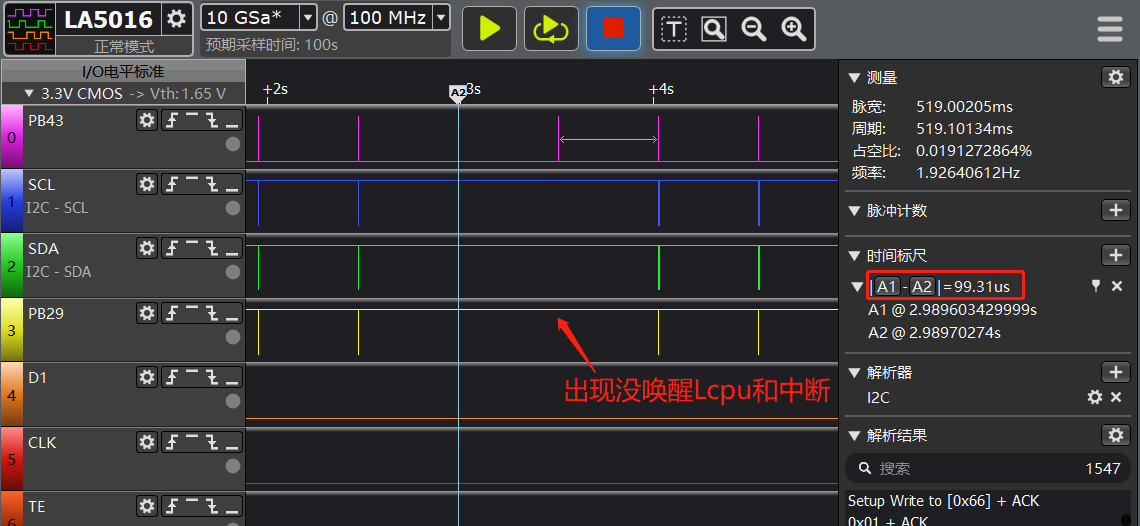
As shown in the figure below, there is a probability that Lcpu cannot be woken up and an interrupt cannot be generated.
Root cause:
When the pulse width of the PB43 heart-rate interrupt is only 99us, this customer uses the RC10K oscillator in standby, with a frequency between 8k and 10k. The corresponding maximum clock period is 125us, so this 99us pulse may fail to wake up Lcpu from standby. Solution:
Modify the peripheral register or firmware so that the interrupt pulse width is greater than the clock period. With the RC10K oscillator, the pulse width must be at least greater than 125us.
alt text

3.2 Global interrupt enable/disable functions

uint32_t mask;
 mask = rt_hw_interrupt_disable(); /*关中断*/
 rt_hw_interrupt_enable(mask);  /*开中断*/
Previous
2 Timer-Related
Next
4 Watchdog-Related

2025, SiFli

Made with Sphinx and Shibuya theme.